
Target Age Group
This module is designed for migrant pupils aged 7-14 years, with internal differentiation for two developmental and linguistic sub-groups:
The module is particularly suitable for pupils at CEFR pre-A1 to A2/B1 transition levels, depending on age and previous exposure to the language of schooling. Activities are differentiated through:
The module is intended for learners from migrant and refugee backgrounds who are at an early or intermediate stage of social and linguistic integration into the host-country educational environment.
Estimated Duration
Total estimated duration: approximately 180 minutes
The module is divided into 3 interconnected sessions, each lasting approximately 55-60 minutes:
Each session follows the TELMS pedagogical structure:
Additional optional extension activities may be implemented asynchronously through the TELMS digital environment or as homework.
This module is grounded in the pedagogical principles of the CARE project and the TELMS-based mentoring methodology as an extension of the CLIL-based language courses. The module specifically focuses on the development of Basic Interpersonal Communicative Skills (BICS), understood as the social language needed for everyday interaction, relationship-building, participation in classroom routines, and successful integration into the school and local community.
The module responds directly to the linguistic and psychosocial needs of migrant pupils who often experience challenges related to:
The pedagogical approach combines:
The module reflects Cummins’ distinction (*The Cummins distinction usually refers to the distinction made by Jim Cummins between two types of language proficiency in bilingual and second-language education) between BICS and CALP by prioritising contextualised, socially embedded communication tasks that enable learners to function confidently in everyday situations before progressing toward more cognitively demanding academic language. Activities therefore focus on:
The module also integrates elements of CLIL methodology, as communication tasks are embedded within meaningful contexts and authentic problem-solving situations rather than isolated grammar instruction. Language acquisition occurs through interaction, participation, and purposeful communication.
From a digital competence perspective, the module aligns with key areas of the European Digital Competence Framework (DigComp), particularly:
The module additionally supports the development of:
The TELMS mentoring structure ensures that language learning is not treated as isolated linguistic training, but as part of a broader process of social participation, emotional wellbeing, and digital inclusion. The mentor acts as both linguistic facilitator and supportive guide, creating safe communicative spaces where migrant pupils can gradually develop confidence in using the language of schooling.
The module is particularly relevant during the early and intermediate phases of integration because migrant learners often first require practical communicative language for social survival and relationship-building before they can successfully engage in cognitively demanding academic discourse. By strengthening BICS competencies through structured social interaction and digitally mediated activities, the module establishes the communicative foundation necessary for later CALP development.
Furthermore, the module promotes equitable participation in digitally mediated educational environments by helping learners:
The integration of digital tools and AI-supported activities reflects contemporary educational realities while ensuring that all technological interaction remains pedagogically guided, age-appropriate, and ethically supervised.
Specific mentor roles within this module include:
The mentor demonstrates functional everyday communication, models pronunciation and interaction strategies, and provides comprehensible examples adapted to learners’ language levels.
The mentor supports peer collaboration, resolves communication misunderstandings constructively, and encourages respectful intercultural interaction.
The mentor introduces digital tools gradually, ensures safe technology use, explains platform functions clearly, and supports learners with varying levels of digital competence.
The mentor supervises all AI use, helping pupils understand that AI-generated content may contain errors or biases. The mentor encourages pupils to question, verify, compare, and adapt AI outputs critically.
The mentor promotes belonging, emotional safety, confidence-building, and inclusive participation through positive reinforcement and relationship-centred mentoring.
The mentor’s role is essential because migrant pupils frequently require structured guidance not only in language acquisition, but also in navigating social expectations, interpreting implicit communication norms, and building confidence in unfamiliar educational settings.
The mentor supports language acquisition through:
To manage cognitive load effectively, the mentor breaks complex tasks into smaller steps, sequences activities progressively, combines visual and oral instructions, limits excessive linguistic overload, uses predictable routines, checks comprehension regularly, and offers differentiated support pathways.
The mentor also creates psychologically safe communication spaces, validates learners’ multilingual identities, acknowledges migration-related challenges sensitively, encourages risk-taking in communication, promotes peer acceptance and empathy, and reinforces participation rather than linguistic perfection.
In the TELMS framework, the mentor adopts a facilitative rather than purely transmissive teaching approach. The mentor encourages active participation, exploratory dialogue, and collaborative problem-solving while maintaining clear pedagogical structure.
The mentor is encouraged to adopt:
The mentor should continuously monitor pupils’ engagement, emotional comfort, linguistic participation, and digital confidence while adapting activities flexibly according to learner needs.
The integration of AI within the module serves several purposes:
AI use should be age-appropriate, ethically supervised, transparent, critically discussed, aligned with learning objectives, and adapted to learners’ linguistic levels.
Pupils are explicitly taught that AI is a learning assistant rather than an authority. Before using any AI-generated suggestion, learners are encouraged to ask: Is this understandable? Is it polite? Does it match what I want to say? Together with the mentor they compare AI responses with authentic classroom communication, recognising that AI may produce inaccurate, culturally inappropriate or overly complex language. Final communicative decisions always remain with the learner and mentor.
Mentor’s AI Use
The mentor uses AI tools primarily for preparation, differentiation, scaffolding, and formative support.
Throughout the three learning scenarios, the mentor integrates AI purposefully to prepare differentiated learning materials while maintaining full pedagogical control. Before Scenario 1, AI is used to generate simplified classroom vocabulary lists, multilingual labels, pronunciation models and differentiated Wordwall activities. Before Scenario 2, AI supports the creation of dialogue models, sentence frames and alternative role-play scripts adapted to different CEFR levels. Before Scenario 3, AI assists in generating hobby-related vocabulary banks, reflection prompts and examples of short self-introduction scripts that pupils later personalise. All AI-generated materials are reviewed, adapted and validated by the mentor before being introduced to learners.
The mentor can use tools such as:
in order to simplify texts, generate vocabulary lists, create differentiated conversation prompts, generate everyday conversation examples/ social communication scenarios, produce multilingual support materials, or adapt instructions to varying proficiency levels.
Besides, thanks to AI tools, the mentor can create visual flashcards, communication boards, pictorial supports, captioned images, pronunciation models, and simple interactive quizzes.
Thinking about Formative Assessment Support, the mentor may use AI tools to generate differentiated reflection questions, create quick formative quizzes, suggest scaffolding strategies, and identify alternative vocabulary explanations.
However, the mentor always:
Pupils’ AI Use
Pupils interact with AI only during selected learning tasks and always under direct mentor supervision. AI functions as a communication scaffold rather than a replacement for authentic peer interaction. Learners are encouraged to compare AI suggestions with their own ideas, discuss alternative expressions, and decide which language is most appropriate for the communicative situation.
Scenario 1 – The Interactive Classroom Sorter
During pronunciation and vocabulary practice, pupils may use ChatGPT Voice (or another mentor-selected AI speech assistant) to:
The AI interaction is immediately followed by authentic communication with classmates using the learned vocabulary during pair activities.
Scenario 2 – Ordering at the Canteen: Comic Conversations
After rehearsing role-play with peers, pupils may use ChatGPT to:
Pupils then independently select which suggestions to include in their Canva comic strip, discussing with their partner whether the AI-generated dialogue sounds natural and appropriate for the situation.
Scenario 3 – My Hobbies Audio Board
While preparing their digital hobby presentation, pupils may use ChatGPT to:
Pupils finally create their own multimodal product using Padlet and Vocaroo, combining their own voice recordings with personally selected images and captions rather than relying on AI-generated content.
Developing Critical AI Literacy
Across all scenarios pupils are guided to:
AI therefore supports language practice and confidence-building while all final decisions, communication and assessment remain human-led.
Throughout all activities, the mentor explicitly discusses:
The progression of AI use mirrors the progression of the module itself: AI first supports vocabulary and pronunciation (Scenario 1), then dialogue development and social interaction (Scenario 2), and finally self-expression and reflection through multimodal communication (Scenario 3), while authentic human interaction remains the primary learning objective.
This module supports the development of key digital competences in line with the DigComp framework. Pupils learn how to communicate and collaborate appropriately in digital environments, create simple multimodal content, and interact safely and responsibly online. Through guided use of digital and AI-supported tools, learners also strengthen their ability to solve simple communication problems, navigate digital resources, and critically reflect on digital content.
The module primarily develops Basic Interpersonal Communicative Skills (BICS) by helping pupils participate in everyday social interaction, classroom routines, and peer communication. Learners practise functional vocabulary, listening comprehension, asking and answering questions, expressing emotions and preferences, and using communication repair strategies. At the same time, the module gradually introduces early CALP-related elements such as structured explanations, reflective language, and simple reasoning tasks that prepare learners for more cognitively demanding academic communication.
The module strengthens pupils’ self-confidence, collaboration skills, intercultural awareness, empathy, and sense of belonging within the school community. Through cooperative activities and guided reflection, learners develop emotional expression, resilience, learner autonomy, and respectful participation in multilingual and digitally mediated environments.
| Tool Name | Purpose / Description of Use |
| ChatGPT | Used under mentor supervision to generate simple dialogues, vocabulary practice activities, role-play prompts, and reflective questions adapted to learners’ language levels. |
| Canva | Used to create visual communication boards, digital posters, simple social stories, and multimodal presentations supporting everyday language development. |
| Wordwall | Used for vocabulary revision, communication games, matching activities, and interactive BICS practice. |
| Padlet | Used for collaborative communication tasks, sharing ideas, posting short messages, and creating multilingual classroom interaction spaces. |
| Vocaroo | Used for simple voice-recording activities, pronunciation practice, oral reflections, and confidence-building speaking tasks in a low-pressure digital environment. |
Target Age Group
7-10 years (adaptable for 11-14 years with increased linguistic complexity and reduced scaffolding)
Estimated Duration
45-50 minutes
Scenario Summary
In this introductory BICS-focused scenario, migrant pupils explore everyday classroom language through interactive multimodal activities. Using drag-and-drop digital games, visual flashcards, audio support, and simple voice-recording tasks, pupils learn to identify and pronounce classroom objects, numbers, and basic interaction phrases. The scenario reduces linguistic pressure through Digital Multimodal Composing (DMC), allowing learners to rely on images, sounds, gestures, and repetition while gradually building confidence in social classroom communication. The activities help pupils familiarise themselves with the classroom environment and establish a sense of belonging within the new educational setting.
Linguistic Objectives (BICS/CALP)
Digital Objectives
Personal/Social Objectives
| Tool / Material | Purpose / Notes on Use |
| Wordwall | Used for drag-and-drop vocabulary matching games linking images, audio, and classroom objects. |
| Canva flashcards | Used for visual vocabulary presentation and multimodal language scaffolding. |
| Vocaroo | Used for simple pronunciation recording and oral repetition activities in a low-pressure environment. |
| Interactive whiteboard/ projector | Used for collective modelling, visual support, and guided interaction. |
| Real classroom objects | Used to connect digital activities with authentic classroom context and sensory learning. |
Opening Phase (Warm-up)
[e.g.10 minutes]
The mentor welcomes pupils using simple greetings supported by gestures, visuals, and facial expressions. Using Canva visual flashcards and real classroom objects (e.g. pencil, book, ruler, backpack), the mentor introduces key vocabulary through repetition, pointing, and modelling pronunciation. Pupils repeat words chorally and individually without pressure for accuracy. The mentor establishes a safe atmosphere by encouraging multilingual participation and allowing pupils to answer using gestures or single words if needed. A short interactive “Find the Object” game is played to activate curiosity and reduce communication anxiety.
Core Learning Phase
[e.g. 25-35 minutes]
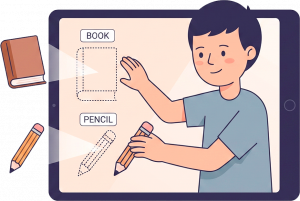
Activity A: Interactive Vocabulary Sorter
Pupils use Wordwall on tablets or the interactive whiteboard to complete a drag-and-drop activity matching classroom images with spoken and written vocabulary. Audio support in the target language helps pupils connect pronunciation with visual meaning, reducing cognitive overload through multimodal scaffolding.
The mentor circulates, models language, repeats instructions slowly, and provides sentence starters such as:
Activity B: Pair Communication Practice
In pairs, pupils complete a simple classroom scavenger hunt using visual cue cards. They ask and answer short questions while locating classroom objects:
The mentor supports peer interaction and encourages non-verbal communication strategies where necessary.
Activity C: Voice Recording with Vocaroo
Pupils record themselves saying 3-5 classroom words or a simple sentence using Vocaroo. They may repeat after the mentor or use visual prompts. The activity focuses on confidence-building rather than pronunciation accuracy. Pupils can re-record if they wish, promoting learner autonomy and self-monitoring.
Closing Phase & Formative Assessment
[e.g. 10 minutes]
The mentor gathers pupils in a reflection circle and revisits the key vocabulary visually. Pupils choose one classroom object card and say or point to the corresponding word. Learners then complete a simple exit reflection using sentence prompts or emojis:
Peer encouragement is promoted through applause or positive gestures after recordings or responses. The mentor informally observes participation, confidence, willingness to communicate, and ability to connect images with vocabulary.
Adaptation Notes
For pupils with very limited language proficiency, the mentor may reduce the number of vocabulary items, use additional native-language audio support, and allow pointing or gestures instead of oral production. Younger learners benefit from more repetition, movement-based activities, and visual reinforcement. Older learners (11-14) may extend the activity by forming complete sentences or categorising classroom objects according to function or colour.
For SEN learners, visual schedules, simplified interfaces, reduced sensory stimulation, and additional processing time may be provided. If limited technology is available, the mentor may replace digital tasks with printable flashcards and collaborative board games while maintaining multimodal interaction principles.
The mentor should maintain predictable routines and frequent emotional reassurance throughout the activity to support newly arrived migrant learners experiencing communication anxiety.
Reflection Routine
“One Thing I Learned – One Word I Remember”
At the end of the session, pupils share:
Learners may respond orally, visually, or by pointing to images. This routine supports vocabulary retention, lowers reflective pressure, and encourages positive self-recognition of progress. It also reinforces the connection between language learning and emotional integration into the classroom environment.
Expected Outcomes
By the end of this activity, pupils should be able to:
Pupils should also demonstrate greater familiarity with the physical and social classroom environment, contributing to reduced communication anxiety and improved participation.
Tool
Wordwall
Activity Description
Pupils complete a drag-and-drop matching activity in which they connect classroom object images with spoken and written vocabulary. After matching, pupils listen again to the audio and repeat the words aloud individually or in pairs. The activity may be repeated multiple times to reinforce pronunciation and vocabulary recognition.
Content
Images and audio recordings of classroom vocabulary:
Language Focus
Recognition and pronunciation of basic classroom vocabulary and simple noun structures using “This is a…” patterns.
Tool
Canva (digital or printable flashcards)
Activity Description
Pupils receive a visual classroom map with missing labels. They identify classroom objects and place or write the correct vocabulary labels. More advanced learners may create short sentences describing object locations, e.g. “The pencil is on the desk.”
Content
Visual classroom scene including labelled and unlabelled classroom objects, positional vocabulary, icons, and colour coding.
Language Focus
Classroom vocabulary, location phrases (incl. prepositions), simple sentence construction, and oral repetition practice.
Tool
Vocaroo + Printed Reflection Sheet
Activity Description
Pupils record themselves saying selected classroom words or short phrases and then complete a simple reflection sheet by circling emojis or colouring confidence indicators related to speaking tasks. Learners may listen to their recordings and compare pronunciation with mentor modelling.
Content
Pronunciation prompts, visual speaking cues, confidence emojis, and sentence starters:
Language Focus
Pronunciation practice, oral repetition, vocabulary recall, and confidence-building in spoken classroom interaction.
Target Age Group
11-14 years (adaptable for 7-10 years with simplified dialogues, visual sentence frames, and increased mentor scaffolding).
Estimated Duration
55-60 minutes
Scenario Summary
In this progressively more complex BICS-oriented scenario, pupils participate in role-playing activities simulating a school canteen or small restaurant interaction. Learners practise functional everyday communication such as greeting, asking for food, making polite requests, responding appropriately, and taking conversational turns. After rehearsing oral interaction through gestures, peer collaboration, and visual supports, pupils use Canva to create a short digital comic strip representing their dialogue. Through Digital Multimodal Composing (DMC), pupils combine speech, visuals, and narrative sequencing to reduce linguistic pressure while strengthening communicative confidence and social participation.
Linguistic Objectives (BICS/CALP)
Digital Objectives
Personal/Social Objectives
| Tool / Material | Purpose / Notes on Use |
| Canva | Used to create digital comic strips illustrating everyday canteen conversations and multimodal storytelling. |
| Wordwall | Used for vocabulary revision and interactive matching activities related to food, drinks, and polite expressions. |
| ChatGPT (mentor-supervised) | Used to generate differentiated dialogue examples, sentence starters, and communication prompts. |
| Printed Dialogue Cards | Used to scaffold oral interaction and support less confident learners during role-play activities. |
| Real or Visual Food Props | Used to create authentic communication contexts and reduce cognitive load through visual association. |
Opening Phase (Warm-up)
[e.g. 10 minutes]
The mentor introduces food vocabulary and polite expressions using visual flashcards, gestures, and real or printed food images. Pupils repeat key phrases chorally and practise simple conversational patterns:
A short interactive Wordwall activity is used to match food vocabulary with pictures and audio support. The mentor models conversational turn-taking using exaggerated gestures and slow speech to reduce linguistic anxiety and activate prior knowledge.
Core Learning Phase
[e.g. 25-35 minutes]
Activity A: Guided Role-Play
Pupils work in pairs or small groups to simulate a school canteen interaction. One learner acts as the server while another acts as the customer. Dialogue cards and visual prompts support interaction.
Example exchanges include:
The mentor circulates continuously, modelling pronunciation, encouraging participation, and scaffolding interaction where necessary. Learners may use gestures, pointing, or visual supports if verbal production is limited.
Activity B: Comic Strip Creation (Digital Multimodal Composing)
Using Canva, pupils create a short 4-6 panel comic strip illustrating their restaurant or canteen dialogue. They select characters, backgrounds, food images, and speech bubbles to visually represent the conversation.
The activity reduces cognitive pressure because pupils communicate meaning through both visual and linguistic modes. The mentor may use ChatGPT beforehand to generate simplified or differentiated sample dialogues depending on learners’ proficiency levels.
Activity C: Pair Sharing
Pairs briefly present their comic strips to another group. Pupils identify polite expressions and key vocabulary used by peers. The mentor reinforces respectful listening and supportive peer feedback.
Closing Phase & Formative Assessment
[e.g. 10 minutes]
The mentor revisits key expressions orally and visually. Pupils participate in a quick “Polite Phrase Circle,” where each learner says or selects one useful expression from the lesson.
Exit prompts include:
Pupils may respond orally, by pointing to dialogue cards, or through emojis. Informal formative assessment focuses on:
The mentor provides positive reinforcement focused on communication effort rather than grammatical accuracy.
Adaptation Notes
For learners with lower language proficiency, the mentor may provide partially completed comic templates, bilingual vocabulary cards, audio sentence models, and simplified two-line dialogues. Younger pupils may create shorter comic strips with more visual than written content.
For more advanced learners, the mentor may encourage:
SEN learners may be equipped with larger visuals, colour-coded speech bubbles, reduced writing demands, oral rather than written comic narration. They can benefit from additional processing time.
If digital devices are unavailable, pupils may create paper-based comic strips using printed templates while still engaging in multimodal storytelling and role-play.
The mentor should maintain a supportive and low-pressure atmosphere where communication attempts are consistently validated.
Reflection Routine
“I Said – I Shared – I Learned”
At the end of the session, pupils reflect on:
This routine reinforces communicative participation, supports self-awareness, and encourages pupils to recognise social interaction as a successful achievement rather than focusing solely on language accuracy.
Expected Outcomes
By the end of this activity, pupils should be able to:
Learners should also show greater familiarity with socially appropriate interaction patterns used in school and community contexts.
Tool
Wordwall
Activity Description
Pupils complete an interactive matching activity connecting food vocabulary and polite expressions with images and audio recordings. After matching, learners practise mini-dialogues orally with a partner using the vocabulary from the game.
Content
Food and drink vocabulary:
Polite expressions:
Language Focus
Everyday BICS communication, polite requests, food vocabulary, pronunciation, and turn-taking.
Tool
Canva
Activity Description
Pupils design a 4-panel comic strip illustrating a canteen conversation (preparing storyboards). They add speech bubbles, characters, and visual details to show the interaction sequence. More advanced learners may add emotions or additional dialogue lines.
Content
Comic templates, speech bubble prompts, restaurant/canteen backgrounds, character avatars, and food illustrations.
Language Focus
Dialogue sequencing, conversational structures, polite requests, greetings, and simple narrative organisation.
Tool
Printed Dialogue Builder Sheet
Activity Description
Learners organise cut-out dialogue strips into the correct conversation order before practising the dialogue orally with a partner. Pupils then personalise the conversation by changing food items or adding emotions.
Content
Sentence strips such as (selected examples):
Visual food cues and emotion icons are included for support.
Language Focus
Turn-taking, sequencing conversations, functional social language, and oral interaction fluency.

Target Age Group
7-14 years (differentiated through linguistic complexity, level of independence, and length of oral production)
Estimated Duration
45-50 minutes
Scenario Summary
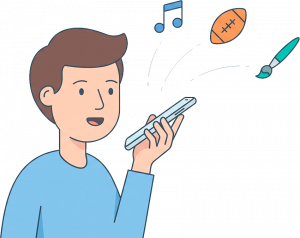
In this final and most communicatively autonomous BICS-focused scenario, pupils create short personal audio introductions about their hobbies, interests, and favourite activities using simple voice-recording tools such as Vocaroo or Flip. Learners then upload or share their recordings on a collaborative Padlet board where classmates can listen and respond using emojis, comments, or visual reactions. Through Digital Multimodal Composing (DMC), pupils combine oral language, digital participation, and personal storytelling to strengthen communicative confidence, pronunciation, and social belonging while engaging safely in collaborative online interaction.
Linguistic Objectives (BICS/CALP)
Digital Objectives
Personal/Social Objectives
| Tool / Material | Purpose / Notes on Use |
| Vocaroo/ Flip | Used for recording short personal audio introductions and practising pronunciation in a low-pressure environment. |
| Padlet | Used as a collaborative digital board where pupils upload recordings and interact with peers’ content. |
| Canva Visual Prompt Cards | Used to support vocabulary related to hobbies, sports, music, games, and free-time activities. |
| ChatGPT (mentor-supervised) | Used to generate differentiated sentence starters and hobby vocabulary support. |
| Headphones / Tablets | Used for listening to peer recordings and completing individual oral tasks comfortably. |
Opening Phase (Warm-up)
[e.g. 10 minutes]
The mentor introduces hobby-related vocabulary using visual cards, gestures, and simple oral modelling. Pupils repeat words and short phrases connected to free-time activities:
The mentor creates a supportive atmosphere by sharing a short personal example and encouraging pupils to use gestures, visuals, or single words if needed. A quick movement-based game is used in which pupils mime hobbies while classmates guess the activity.
Visual supports and multilingual clarification may be provided to reduce cognitive load and communication anxiety.
Core Learning Phase
[e.g. 25-35 minutes]
Activity A: Guided Oral Preparation
Pupils prepare a short self-introduction using sentence frames and visual prompts. Younger or less confident learners may complete simple structures:
Older or more advanced learners may extend their recordings with reasons or additional details:
The mentor models pronunciation slowly, offers immediate encouragement, and validates all communication attempts to strengthen oral confidence.
Activity B: Audio Recording with Vocaroo or Flip
Pupils record a short audio greeting about their hobbies and interests using Vocaroo or Flip. Learners may re-record if they wish, supporting self-monitoring and learner autonomy. The mentor provides “soft scaffolding” through:
Activity C: Collaborative Padlet Sharing
The recordings are uploaded or linked to a shared Padlet board. Pupils listen to classmates’ recordings using headphones and react respectfully through:
The mentor explicitly discusses respectful online communication, active listening, and safe participation in collaborative digital environments.
Closing Phase & Formative Assessment
[e.g. 10 minutes]
The mentor gathers pupils for a short reflection discussion focused on confidence and communication rather than linguistic accuracy. Learners respond to simple prompts:
Pupils may respond orally, with emojis, or by pointing to visuals. Peer encouragement is promoted through positive reactions and applause after listening activities.
The mentor informally observes:
The session ends with a collective celebration of multilingual voices and personal identities.
Adaptation Notes
For learners with very limited language proficiency, the mentor may allow:
Younger pupils may use more visual scaffolding and shorter speaking tasks, while older learners can extend recordings by describing routines, emotions, or reasons connected to hobbies.
SEN learners may benefit from:
If technology access is limited, pupils may record using a single shared device or complete the activity as a live oral sharing circle instead of uploading recordings digitally.
The mentor should prioritise emotional safety and celebrate communicative effort rather than pronunciation perfection.
Reflection Routine
“My Voice Matters” Reflection
At the end of the activity, pupils complete the sentence:
This routine encourages self-recognition of communicative progress and reinforces the importance of every learner’s voice within the classroom community. It also supports emotional integration and learner confidence.
Expected Outcomes
By the end of this scenario, pupils should be able to:
Learners should also demonstrate improved willingness to engage in oral interaction and greater familiarity with collaborative digital communication tools.
Tool
Canva
Activity Description
Pupils complete a visual “My Hobbies” profile sheet by selecting or inserting images representing their favourite activities. They then use sentence starters to prepare short oral responses before recording their audio introduction.
Content
Hobby visuals:
Sentence frames:
Language Focus
Hobby vocabulary, self-introduction structures, pronunciation support, and simple preference expressions.
Tool
Padlet
Activity Description
Pupils listen to classmates’ recordings and complete a simple digital response sheet by choosing emojis, icons, or short comments related to the recordings. More advanced learners may write one positive sentence to a peer.
Content
Listening prompts, reaction icons, emoji scales, and peer feedback starters:
Language Focus
Listening comprehension, social interaction language, respectful feedback, and simple conversational responses.
Tool
Vocaroo + Printed Speaking Planner
Activity Description
Before recording, pupils organise their ideas using a speaking planner with visuals and keywords. After recording, they reflect on their confidence level by colouring a self-assessment scale.
Content
Visual speaking organiser including:
Language Focus
Oral fluency, pronunciation practice, vocabulary recall, and confidence-building in spoken self-expression.
Throughout all three scenarios, the mentor continuously observes pupils’ linguistic participation, emotional comfort, social interaction, and engagement with digital tools in order to provide responsive and differentiated support. Observation within this module is primarily formative, informal, and integrated naturally into the TELMS mentoring process rather than based on formal testing or correction-oriented assessment. The mentor focuses on communicative participation, confidence-building, and gradual integration into the classroom environment.
During Scenario 1 (“The Interactive Classroom Sorter”), the mentor observes whether pupils:
Particular attention is paid to learners’ comfort levels, hesitation patterns, and readiness to engage in classroom communication routines.
During Scenario 2 (“Ordering at the Canteen: Comic Conversations”), the mentor observes:
The mentor also monitors how learners negotiate meaning socially and whether pupils increasingly rely on communication strategies rather than withdrawal or silence.
During Scenario 3 (“My Hobbies Audio Board”), the mentor focuses on:
The mentor additionally observes whether learners demonstrate increasing confidence in presenting personal information and participating in digitally mediated communication spaces.
Observations are recorded informally through brief mentoring notes, simple observation grids, reflective checklists, anecdotal comments, quick post-session summaries, and participation tracking.
Rather than focusing on grammatical correctness, the mentor documents:
These observations help the mentor adapt future scaffolding, pacing, grouping strategies, and language
supports according to learner needs.
At the end of each scenario, pupils participate in short reflection routines and exit activities designed to promote self-awareness, emotional safety, and recognition of communicative progress. Reflection activities are intentionally low-pressure and multimodal in order to remain accessible to learners at early stages of language acquisition.
The module uses simple reflective prompts connected directly to the communicative focus of each session.
Scenario 1 – Exit Questions
These prompts help pupils recognise newly acquired classroom vocabulary and reflect on their emotional comfort within the new learning environment.
Scenario 2 – Exit Questions
These questions encourage learners to reflect on participation in social interaction, polite communication, and collaborative dialogue-building.
Scenario 3 – Exit Questions
These prompts support self-expression, oral confidence, empathy, and peer connection.
Pupils may respond orally, visually, through emojis, by pointing to images, using short written responses, and through digital reactions on Padlet or collaborative boards.
The mentor analyses pupils’ responses to identify communication confidence, vocabulary retention, emotional wellbeing, interaction preferences, levels of engagement, and readiness for more complex communication tasks.
The reflection responses guide subsequent sessions by helping the mentor:
Reflection routines also reinforce the TELMS principle that language development is closely connected to emotional integration, participation, and learner agency rather than linguistic perfection alone.
Peer-assessment activities within this module are designed to strengthen collaborative learning, social belonging, intercultural empathy, and respectful communication. Assessment remains informal, supportive, and participation-oriented in order to maintain psychologically safe learning environments for migrant pupils.
Across the three scenarios, peer feedback activities include:
In Scenario 1, pupils support one another during vocabulary matching and classroom scavenger hunt activities. Peer encouragement is reinforced through positive gestures, shared repetition, and collaborative object identification tasks.
In Scenario 2, learners present comic-strip dialogues to peers in small groups. Pupils identify useful polite expressions and successful communication strategies used by classmates. The mentor models constructive feedback language such as:
In Scenario 3, peer assessment occurs through collaborative Padlet interaction. Pupils listen to classmates’ recordings and respond respectfully using emojis, stickers, short comments, reaction icons, and verbal encouragement.
These activities help learners practise active listening, respectful online communication, empathy, peer recognition, collaborative interaction, and digital citizenship.
The mentor carefully supervises all peer-feedback interactions to ensure that comments remain supportive, culturally sensitive, and emotionally safe. Feedback focuses primarily on:
Peer-assessment activities support the TELMS mentoring approach by promoting learner agency, reducing communication anxiety, and reinforcing the idea that multilingual communication is a shared social process rather than an individual performance task.
Following each scenario, mentors are expected to complete the Teacher Reflection Form included in Annex 4 of the CARE Methodological Guidelines. The reflection process supports continuous pedagogical adaptation and ensures that activities remain responsive to the linguistic, emotional, social, and digital needs of migrant learners.
The mentor reflects systematically on:
Special attention is given to evaluating how digital and AI-supported tools contributed to reducing cognitive load, increasing communicative participation, supporting multimodal understanding, strengthening confidence in oral interaction, and facilitating differentiated instruction.
The mentor also reflects critically on whether AI-generated materials were linguistically and culturally appropriate, whether learners understood the limitations of AI tools, how effectively digital tools supported BICS development, or whether learners remained actively engaged rather than passively consuming digital content.
Post-session reflections help the mentor identify which activities need simplification, if learners need additional emotional or linguistic support, if successful scaffolding strategies are applied, if necessary adjustments in digital tool selection are made. The mentor can also observe if pupils have made suitable progress toward more autonomous communication. Moreover the mentor can reflect whether pupils had enough opportunities for stronger peer collaboration during the activities.
Thanks to this reflective practice the mentor can:
Within the TELMS framework, mentor reflection is understood as an essential component of responsive, learner-centred pedagogy. Reflection ensures that technology, AI integration, and language mentoring remain pedagogically meaningful, emotionally supportive, and aligned with the broader goals of social integration and communicative empowerment for migrant learners.

The implementation of this module within the Polish educational context requires sensitivity to the increasing linguistic, cultural, and educational diversity present in schools due to recent migration processes, including the arrival of refugee and migrant pupils from Ukraine and other countries. Many migrant learners entering Polish schools may experience interrupted educational trajectories, emotional stress related to displacement, limited familiarity with the Polish language, and differing experiences with digital technologies and classroom participation norms.
One important contextual consideration is the wide diversity of language proficiency levels among migrant pupils. Learners may simultaneously develop social communication skills in Polish, literacy in their home language, digital communication competences, and understanding of new educational and behavioural expectations.
The module therefore adopts flexible multilingual and multimodal approaches that allow pupils to communicate through visuals, gestures, audio, simplified oral language, and collaborative interaction.
Within the Polish school context, levels of digital access may vary significantly depending on the region, school infrastructure, and socio-economic conditions. While many schools have interactive whiteboards, internet access, and tablets available, others may rely on limited shared equipment. For this reason, all activities included in the module are designed to remain adaptable for low-technology environments, blended learning contexts, and paper-based alternatives when necessary.
The selected digital tools (e.g. Canva, Wordwall, Padlet, Vocaroo) were chosen because they are freely accessible or offer free educational versions, intuitive for beginner users, suitable for multilingual and multimodal communication, and compatible with school-based implementation.
Another important cultural factor concerns pupils’ emotional readiness to participate in oral communication activities. Some migrant learners may initially avoid speaking as they want to avoid peer judgement due to making mistakes, they have some previous traumatic experiences, or they are unfamiliar with participatory classroom practices.
For this reason, the module prioritises psychologically safe communication spaces, gradual participation, positive reinforcement, and low-pressure interaction routines. Communication effort and participation are valued more highly than grammatical accuracy.
The module also recognises that attitudes towards AI and digital technologies may differ among pupils, families, and educators. Therefore, AI integration remains:
Special emphasis is placed on:
The culturally responsive and trauma-sensitive mentoring approach promoted throughout the module supports inclusion, emotional wellbeing, and respectful intercultural communication within diverse educational communities.
This module is closely aligned with the Polish national curriculum (Podstawa programowa kształcenia ogólnego) and responds directly to the growing educational need to support pupils with migrant and refugee backgrounds within mainstream schools. Its objectives correspond with the broader aims of Polish education defined in the Prawo oświatowe (Journal of Laws 2017, item 59, as amended), particularly those related to equal access to education, social inclusion, development of communication competences, and preparation for active participation in social life.
The activities proposed within the module support the development of practical communication skills emphasised in the national curriculum for primary education, especially within the areas of Polish language education, foreign language learning, integrated early-school education, and social-emotional development.
The curriculum strongly promotes the use of language in authentic communicative situations rather than isolated grammatical instruction, which corresponds directly with the BICS-oriented approach adopted in this module. Through everyday interaction scenarios, collaborative communication tasks, and multimodal storytelling, pupils practise functional language needed for participation in classroom routines, peer interaction, and school life.
The module also reflects the curriculum’s emphasis on developing key competences, particularly communication competences, digital competences, teamwork, creativity, and social participation. These priorities are consistent with the recommendations included both in the Polish educational framework and in European educational policy documents such as the Key Competences for Lifelong Learning (European Council Recommendation, 2018). By integrating oral communication, collaborative learning, and digital participation, the module supports the holistic development of learners within inclusive educational environments.
Particular relevance can also be seen in relation to digital education objectives included in the Polish curriculum. The Ministry of National Education increasingly highlights the importance of responsible and critical use of digital technologies, media literacy, and safe online communication. Through the use of tools such as Padlet, Canva, Wordwall, and Vocaroo, pupils develop practical digital skills connected to communication, collaboration, and content creation, while also learning the principles of digital safety and respectful online interaction. These competences correspond with the educational goals outlined in the Regulation of the Minister of National Education of 14 February 2017 on the core curriculum for primary schools (Rozporządzenie Ministra Edukacji Narodowej z dnia 14 lutego 2017 r. w sprawie podstawy programowej kształcenia ogólnego).
The module additionally reflects current educational priorities in Poland regarding inclusive education and psychosocial support for migrant pupils. In recent years, Polish schools have increasingly implemented integration-oriented educational practices aimed at supporting newly arrived learners in adapting socially, emotionally, and linguistically to the school environment. The mentoring-based and trauma-sensitive structure of this module supports these objectives by creating psychologically safe learning spaces where communicative participation, emotional wellbeing, and learner confidence are prioritised alongside language acquisition.
The use of CLIL-inspired strategies and TELMS mentoring principles also complements the growing interest within Polish educational practice in interdisciplinary, competency-based, and learner-centred methodologies. By combining language learning with digital multimodal composing, social interaction, and reflective learning, the module offers schools a practical framework that may support both curricular implementation and long-term institutional inclusion strategies for culturally and linguistically diverse learners.
Spain (national). This module also aligns closely with the Spanish national curriculum (LOMLOE) and responds to the same need to support pupils with migrant and refugee backgrounds within mainstream schools. Real Decreto 157/2022 establishes the area of Lengua Castellana y Literatura for primary education, organised around oral and multimodal communication in everyday situations and explicitly targeting listening, speaking, and turn-taking skills consistent with the BICS-oriented approach adopted in this module. The curriculum also requires basic communicative competence in at least one additional language for managing everyday situations, directly supporting newly arrived pupils’ functional communication needs. The LOMLOE’s key competences include Competencia digital (safe, critical, and responsible use of digital tools) and Competencia Personal, Social y de Aprender a Aprender (CPSAA), which develops collaboration, self-regulation, and social participation, corresponding to the module’s emphasis on teamwork, creativity, and social-emotional development. Migrant pupils are additionally supported through the aula de acogida (reception classroom) framework, providing intensive language support alongside mainstream integration.
Catalonia (regional). This module also aligns with the Catalan curriculum (Decret 175/2022). The linguistic key competence promotes everyday oral and written communication and, alongside the aula d’acollida reception structure, provides intensive Catalan-language support for newly arrived pupils while enabling continued access to mainstream schooling. As in the Polish curriculum, the Catalan framework emphasises key competences including communication, digital competence, collaboration, creativity, and social participation, structured through the CD (Digital) and CPSAA key competences. The CD competence requires safe, critical, and responsible use of digital tools for communication and content creation, directly relevant to the module’s use of Padlet, Canva, Wordwall, and Vocaroo, while the CPSAA competence supports the self-regulation, resilience, and collaborative skills targeted throughout the module’s reflection routines.
Croatia. This module also aligns with the Croatian national curriculum. The Kurikulum nastavnog predmeta Hrvatski jezik (Croatian Language curriculum) is organised around three interconnected areas — language and communication, literature and creativity, and culture and media — with the “language and communication” strand explicitly developing listening, speaking, reading, and writing through structured everyday communicative situations, closely matching this module’s BICS-oriented scenarios. Digital competence is addressed through the Kurikulum nastavnog predmeta Informatika, whose e-Društvo (e-Society) domain covers online safety, respectful digital communication, and responsible participation in digital spaces, corresponding to the module’s use of collaborative digital tools. Newly arrived migrant and refugee pupils are supported through preparatory classes (pripremna nastava), alongside free Croatian-language courses coordinated by the Ministry of Science and Education.
The Netherlands. This module also aligns with the Dutch curriculum framework. The kerndoelen Nederlands establish four core objectives for oral language proficiency (kerndoelen 1, 2, 3, and 10), which Dutch educational research explicitly links to pupils’ social-emotional development and self-reliance, reflecting the same connection between everyday communication and emotional wellbeing that underlies this module’s BICS approach. Digital competence is addressed through the kerndoelen digitale geletterdheid, which require pupils to use digital systems and media safely, critically, and responsibly, corresponding to the module’s use of Padlet, Canva, Wordwall, and Vocaroo. Newly arrived pupils are supported through taalklassen or nieuwkomersscholen (reception/language classes), typically for about one year, before transitioning into mainstream primary education.